[Editorial] How APV Is Elevating Mobile Video to Professional Standards
The era of filmmaking with a mobile phone has arrived. As anyone can now shoot, edit and share high-quality video, users increasingly expect greater color accuracy, finer detail and more post-production flexibility. In response, Samsung Electronics has developed the Advanced Professional Video (APV) codec and is working to establish it as a global open standard.

Why APV
Codecs may be unfamiliar to many consumers, but they act as invisible engines shaping the user experience. Think of a suitcase — how you pack it determines how much it holds and how easily you can find what you need. Likewise, an efficient codec enables a user to store more high-quality video while improving playback and editing.
Video falls into two categories — casual video, everyday clips we capture and share, and professional video for cinema-grade editing. While casual codecs prioritize compression efficiency, professional codecs must preserve image quality and reproduce colors with precision. Just as overpacking a suitcase can damage or distort its contents, professional video requires a robust codec that preserves every detail.
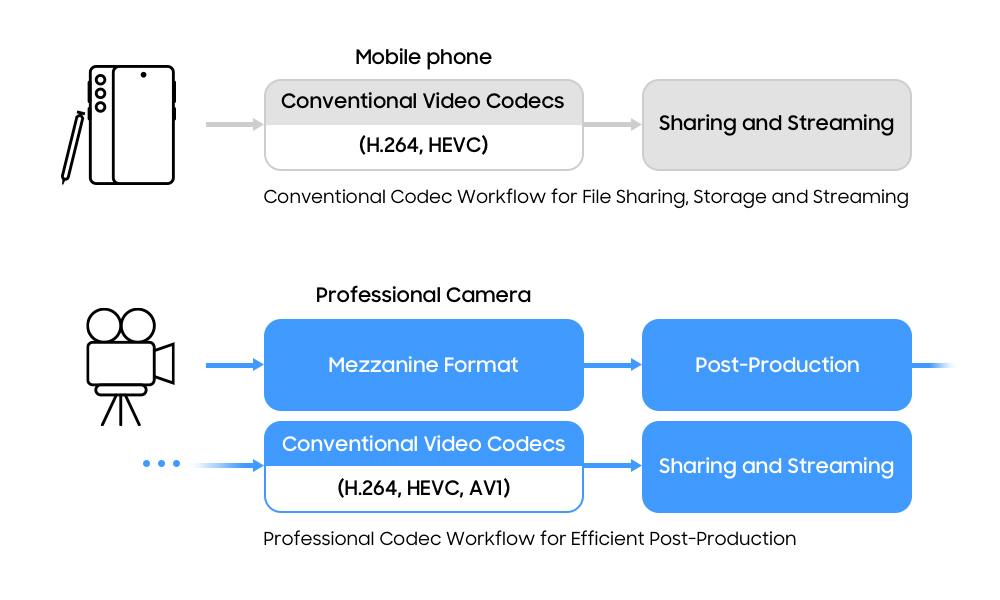
Conventional compression makes it difficult to fully enable mobile post-production — including color grading, where creators apply precise tones to match their artistic vision, and visual effects (VFX). APV was designed to support the entire workflow from capture to final edit while preserving detail even after multiple rounds of recompression.
Reducing Complexity Without Compromise
The biggest technical challenge was reducing complexity. Conventional professional codecs focus on image quality, making them computationally demanding and limiting use to high-end hardware. The goal was to achieve a low-complexity design that mobile processors could handle in real time without compromising quality.
To address this, Samsung introduced lightweight entropy coding1 to reduce computational load and frame tiling2 that enables parallel encoding and decoding across multiple cores. As a result, APV supports real-time processing of up to 8K video on mobile phones while maintaining image quality with minimal loss, even after multiple edits.
| Category | Conventional Video Codec | APV Codec |
|---|---|---|
| Purpose | Viewing and sharing | Professional editing and high-quality preservation |
| Key Focus | Reducing file size (compression efficiency) | Preserving original color and detail at 100% |
| Processing Speed | Standard processing | Real-time 8K processing on mobile phones |
| Use Cases | Social media uploads | Film production, professional advertising, advanced editing |
Building an Open Ecosystem for All
The value of technology lies in how widely it is used. Samsung chose to build an open ecosystem where anyone can adopt and